Should Kampong Lorong Buangkok be preserved as a historical site, or should it be redeveloped to meet Singapore’s urban needs? Discuss both perspectives and provide your opinion.
Minimum of 250 words. Task Fulfilment 10m, Language 20m
Should Kampong Lorong Buangkok be preserved as a historical site, or should it be redeveloped to meet Singapore’s urban needs? Discuss both perspectives and provide your opinion.
Minimum of 250 words. Task Fulfilment 10m, Language 20m
We covered the pre-trip lesson, the onsite lesson and we also did a post-trip lesson which covered a debrief and further discussion on learning points.
Writing Task
Your cousin, Alex from Australia, will be visiting Singapore next month for the first time and has asked for recommendations on interesting places to visit. Write and email to Alex suggested a visit to Kampong Lorong Buangkok. In your email, you should:
You should write a minimum of 250 words. Task Fulfilment 10m, Language 20m
I look forward to the holidays because this gives me the chance to take my students out of the classroom and let them have a go at real-world context. This March holidays, my group of Sec 1 and 2 students visited Singapore’s last kampong, Kampong Lorong Buangkok.
The plan was hatched since the start of Term 1 and arrangements were made in February. Not everyone could make it but for those who could, they passed on their learnings to their classmates in our post-trip class discussions.
There were several objectives to this outing which I had carved out early on. Yes, I had great plans (bearing in mind Social Studies, History, Geography, Situational Writing for Sec 1s and Discursive Writing for Sec 2s)
Firstly, to get a big picture of what kampong life is like. And I think Miss Khong lost the plot after that! No thanks to these teenage brains! Sigh… One student asked me if the residents were just like ordinary Singaporeans, like you and me? Did they wear normal clothes? Kid, are you expecting to meet an alien? Another asked, “Do they ever come out of the kampong? Are they allowed to?” One wanted to know how they got their money? One boy was quite obsessed with their water supply. Do they get water from the river? Obviously, Miss Khong had to manage expectations. Hence, a pre-trip lesson was much needed. Aside from reading articles of kampong life and watching a YouTube video of someone sharing his move from kampong to a HDB flat, there was also a pre-trip worksheet with simple questions they could discuss.
What do I expect to see in the kampong? What do I hope to learn? How do I feel about visiting the kampong?
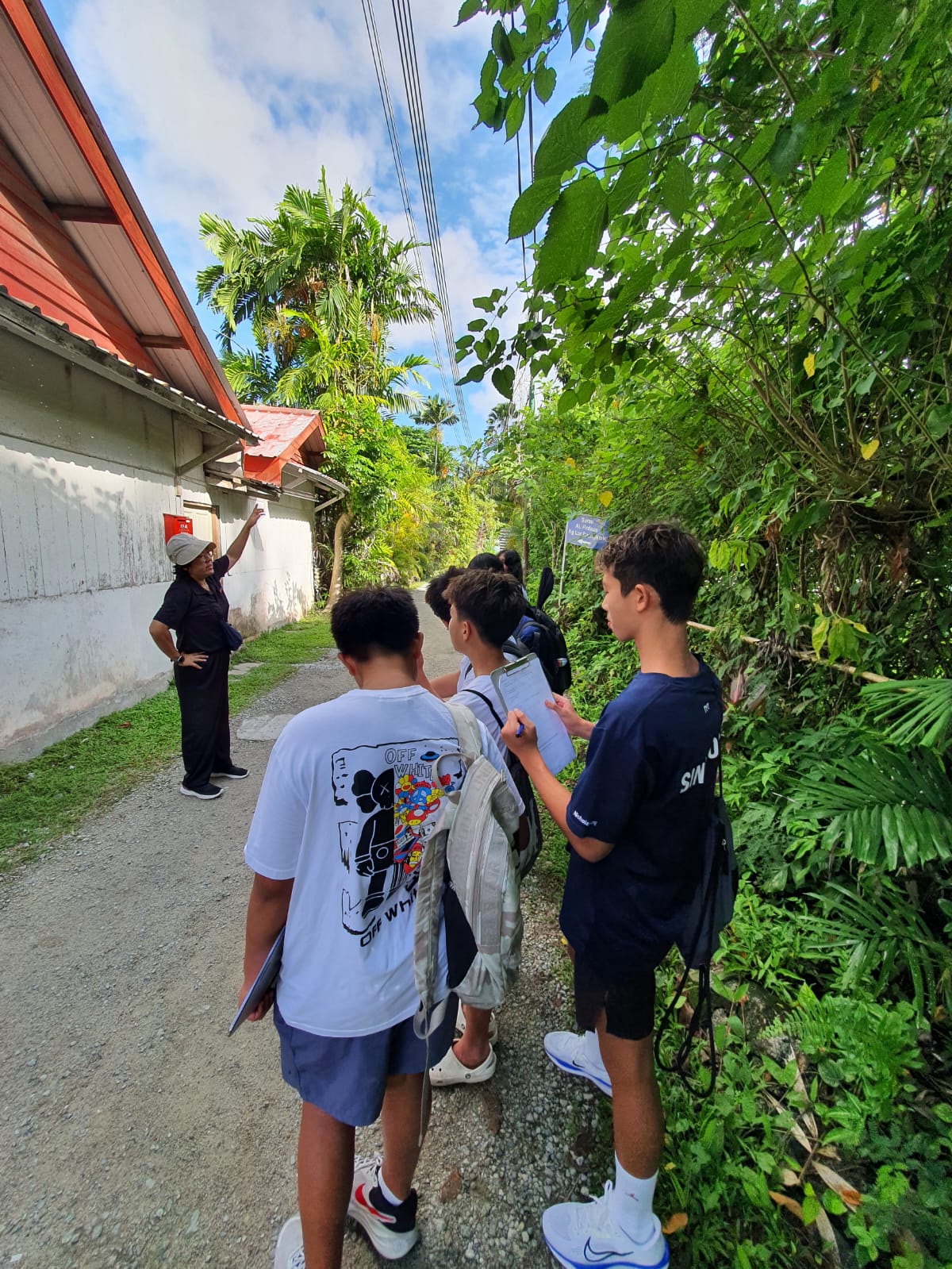
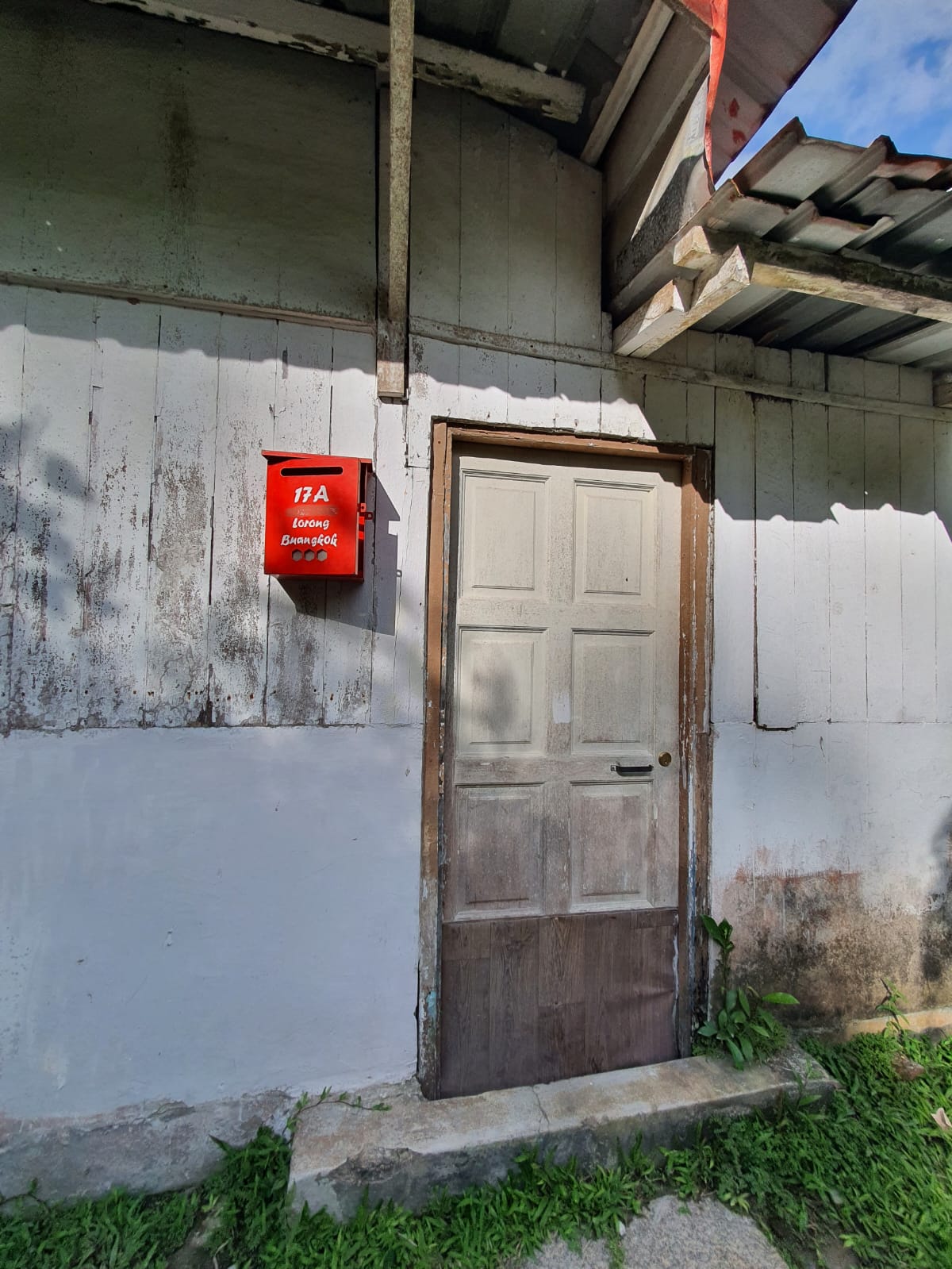

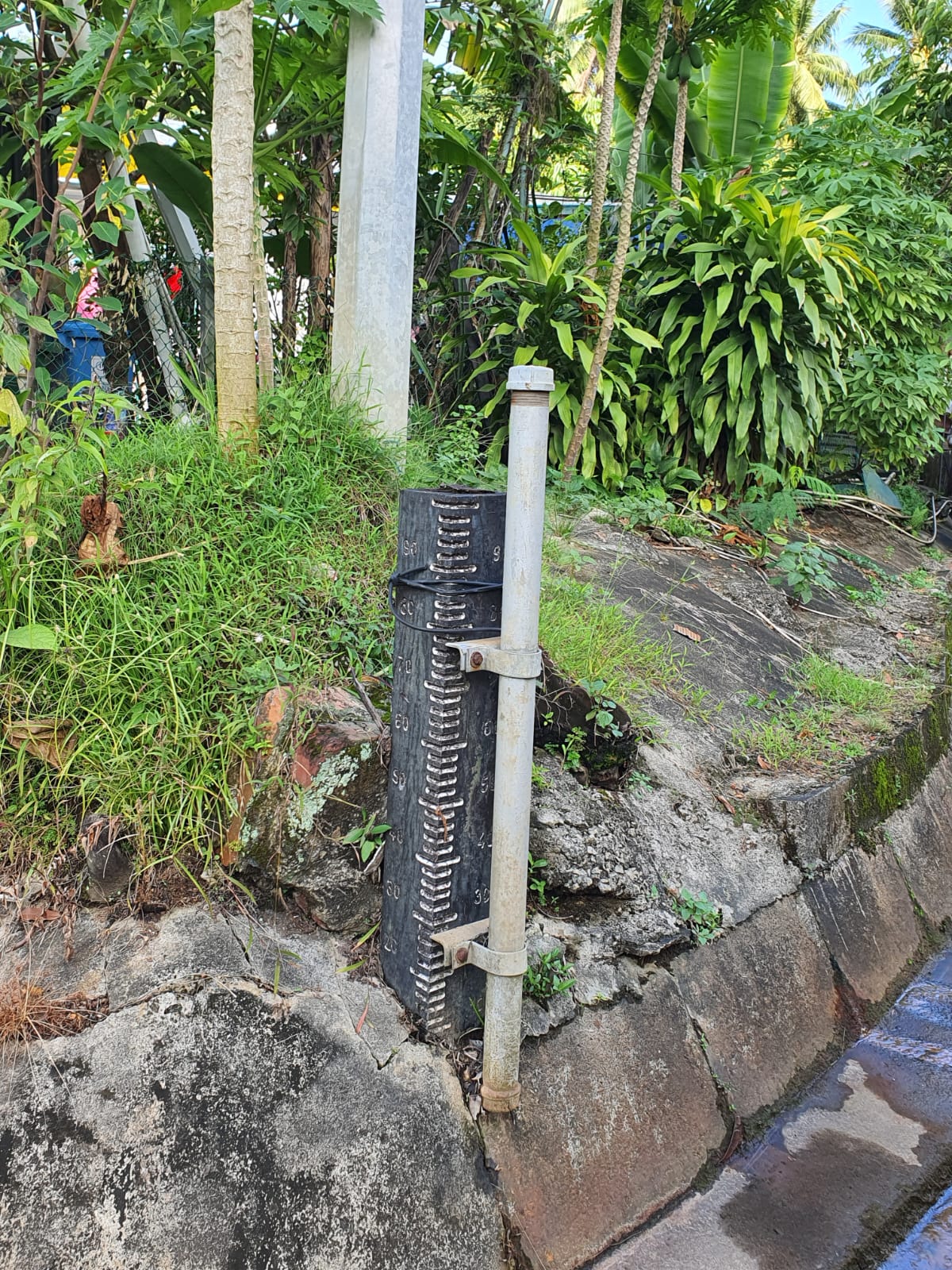
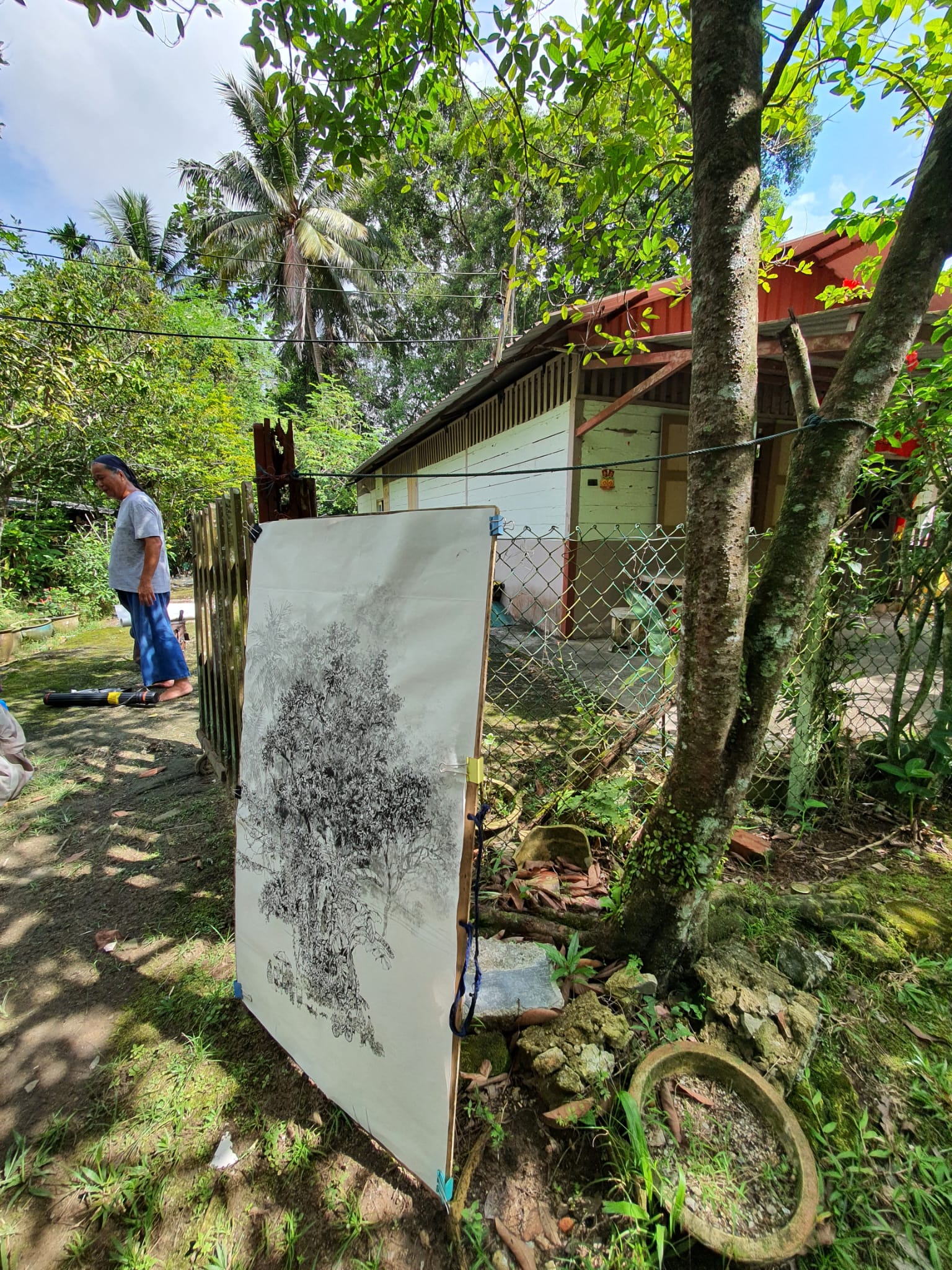
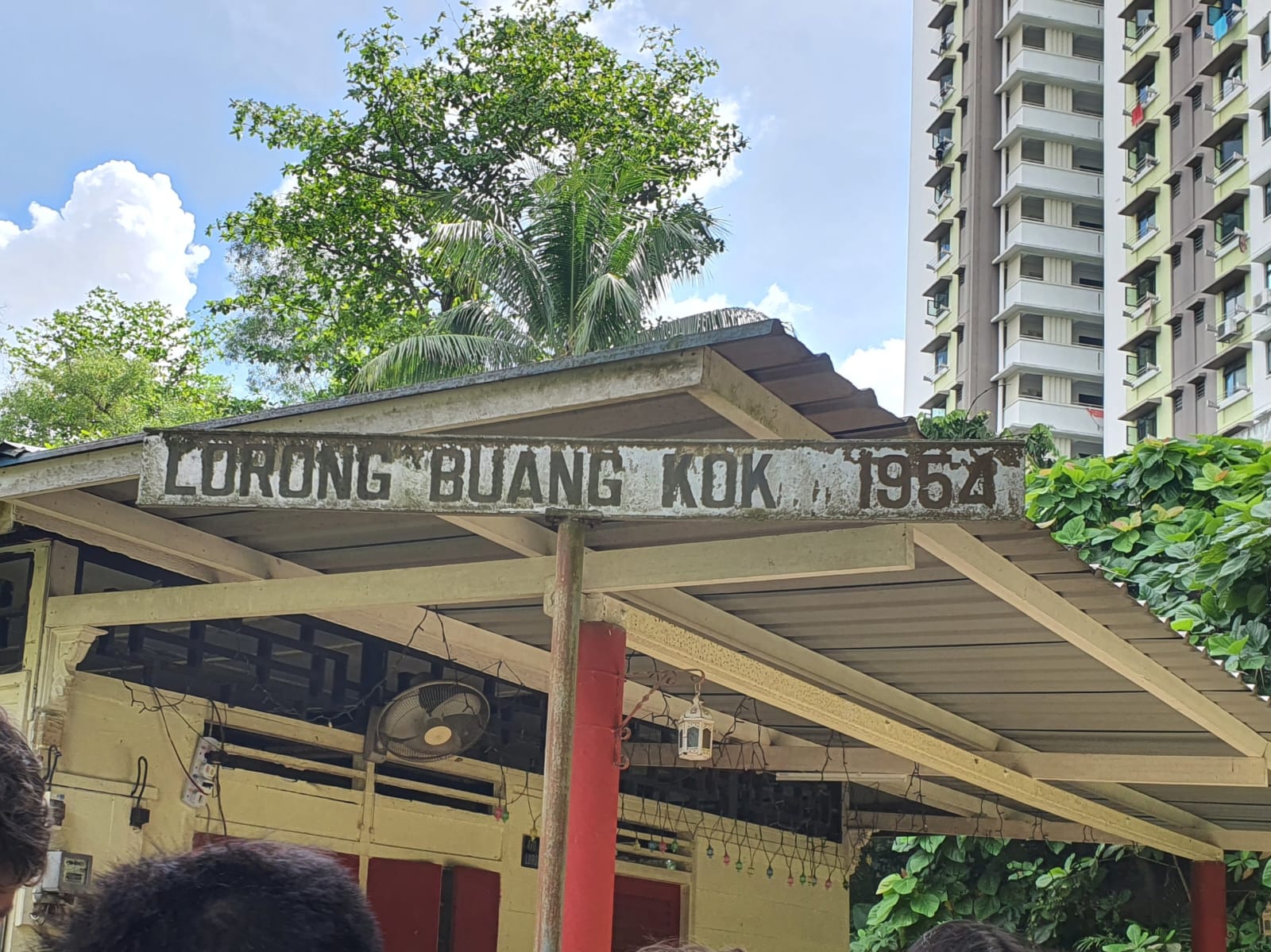
There was a lot of information for the students to take in and we are still downloading and processing all of it!
For one, this kampong holds cultural and historical significance being the last kampong standing on the mainland. After all, kampongs shaped early society, fostering community spirit and solidarity. Hence, this place represents a unique piece of Singapore’s history. What makes it so special is that it is a living museum! The 25 houses dotted around the land are homes to the residents, descendants of the original settlers who were workers at then Woodbridge Hospital, nearby factories or rubber tappers. Part of the land in Buangkok was owned by Singapore United Rubber Plantation Ltd, a subsidiary of a London-based company established in 1919!
While we were there, we picked up on traditional kampong values such as Gotong Royong or community spirit and simple living. We could see that conservation not only promotes cultural tourism but also educational opportunities. My students discovered the breadfruit there! They also learnt that a plant species growing on the side of the gravel-paved road was beneficial for coughs. They realised that our housing estates are well-maintained and manicured thanks to the Town Council workers while the elderly residents of the kampong maintain the place, climbing onto the rooftops to sweep them clean of falling leaves, pruning trees and harvesting fruits. Also, in the kampong there is no litter because everyone feels a personal responsibility for the land. One student pointed out that every house was unique! Each house had a different colour, a different design and a different feel to it. She wanted to know why it was that way? Upon further discussion, the students concluded that the houses were built by the people themselves. No HDB or developer was called in, back in 1956.
However, time brings change and with it, modernisation and redevelopment. Could the residents’ lives be improved with better facilities and amenities? In a country with limited land resources, there is constant pressure to maximise land use. While redevelopment offers economic and infrastructural benefits, there is cultural and historical significance in preserving the kampong. A balanced approach that includes integrating modern elements yet maintaining the kampong’s traditional aspects could ensure that Singapore honours its past while progressing towards the future.
Having said that, this conundrum lies on the shoulders of the kampong’s single landowner and chief, Mdm Sng, a sprightly elderly in her 70s.
When students get back their Composition papers or Personal Recount essays, it is common to see a teacher’s comment – “Sentences are too simple. Don’t use only subject-verb sentences.”
Students who are not avid readers struggle to vary their sentences since this is not a specific lesson topic in the curriculum. Writing is a skill which needs to be developed with practise and over time. Most students join Creative Writing tuition classes to ace their exams. Few want to develop the craft of writing. In this post, I’ve added some examples and practices for you to try out.
A. Begin with an adverb
Rewrite the following sentences by moving the adverbs to the beginning.
1. The fire truck sped furiously along the street, blaring its siren.
2. The firefighters bravely fought the blaze, but they were beaten back by flames.
3. Mario snatched the pot of pasta hungrily, polishing off three plates in under five minutes.
Answer: Furiously, the fire truck sped along the street, blaring its siren. Bravely, the firefighters fought the blaze, but they were beaten back by flames. Hungrily, Mario snatched the pot of pasta, polishing off three plates in under five minutes.
B. Begin with adverb of time (to show transition)
Adverbs that indicate when an action took place. Include words such as: soon, later, moments later, in the blink of an eye…
1. He arrived at his destination moments later.
2. Taylor Swift’s concert came to a close in the blink of an eye.
3. I normally take a nap in the afternoon but today…
Answer: Moments later, he arrived at his destination. In the blink of an eye, Taylor Swift’s concert came to a close. Normally, I take a nap but today…
C. Begin with a prepositional phrase
1. Dinner will be ready by the time you get home.
2. Cobblestone streets echoed with the footsteps of travellers in the heart of the ancient city.
3. The golden sun dipped down below the horizon beyond the towering mountains, painting the sky with brilliant hues of crimson and violet.
Answer: By the time you get home, dinner will be ready. In the heart of the ancient city, cobblestone streets echoed with the footsteps of travellers. Beyond the towering mountains, the golden sun dipped down below the horizon, painting the sky with brilliant hues of crimson and violet.
D. Begin by inverting subject and verb
1. A lone traveller wandered down the winding path, his cloak billowing in the evening breeze.
2. The city had never before witnessed such a breathtaking display of fireworks lighting up the night sky.
3. Taylor Swift had barely stepped onto the stage when thunderous applause erupted from the audience.
Answer: Down the winding path wandered a lone traveller, his cloak billowing in the evening breeze. Never before had the city witnessed such a breathtaking display of fireworks lighting up the night sky. Barely had Taylor Swift stepped onto the stage when thunderous applause erupted from the audience.
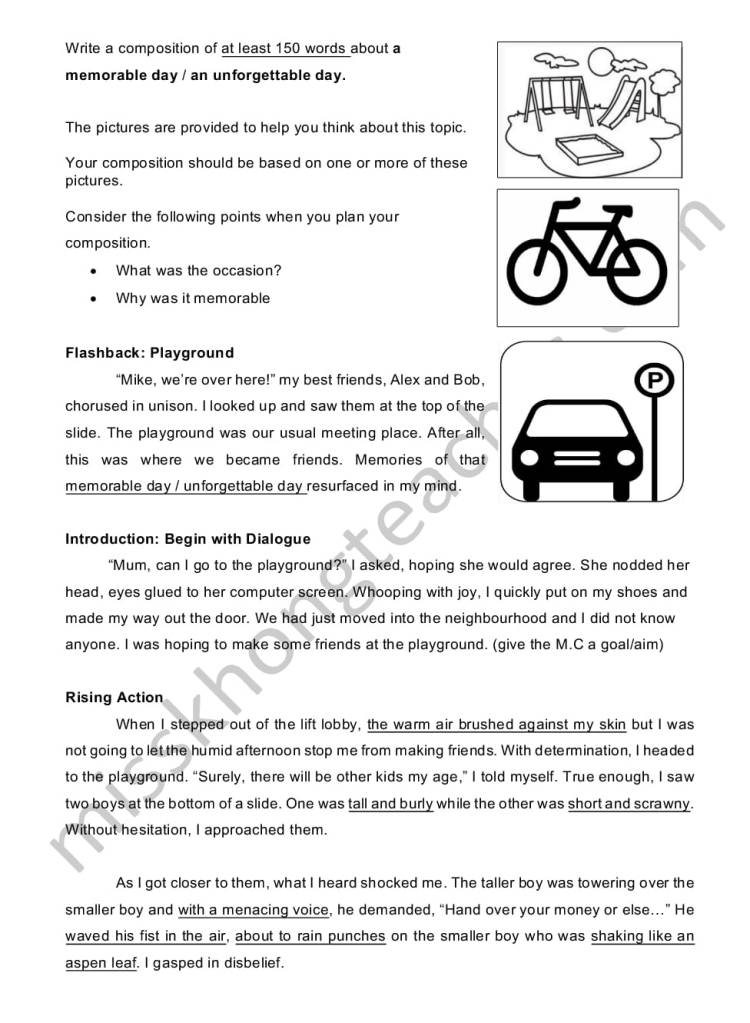
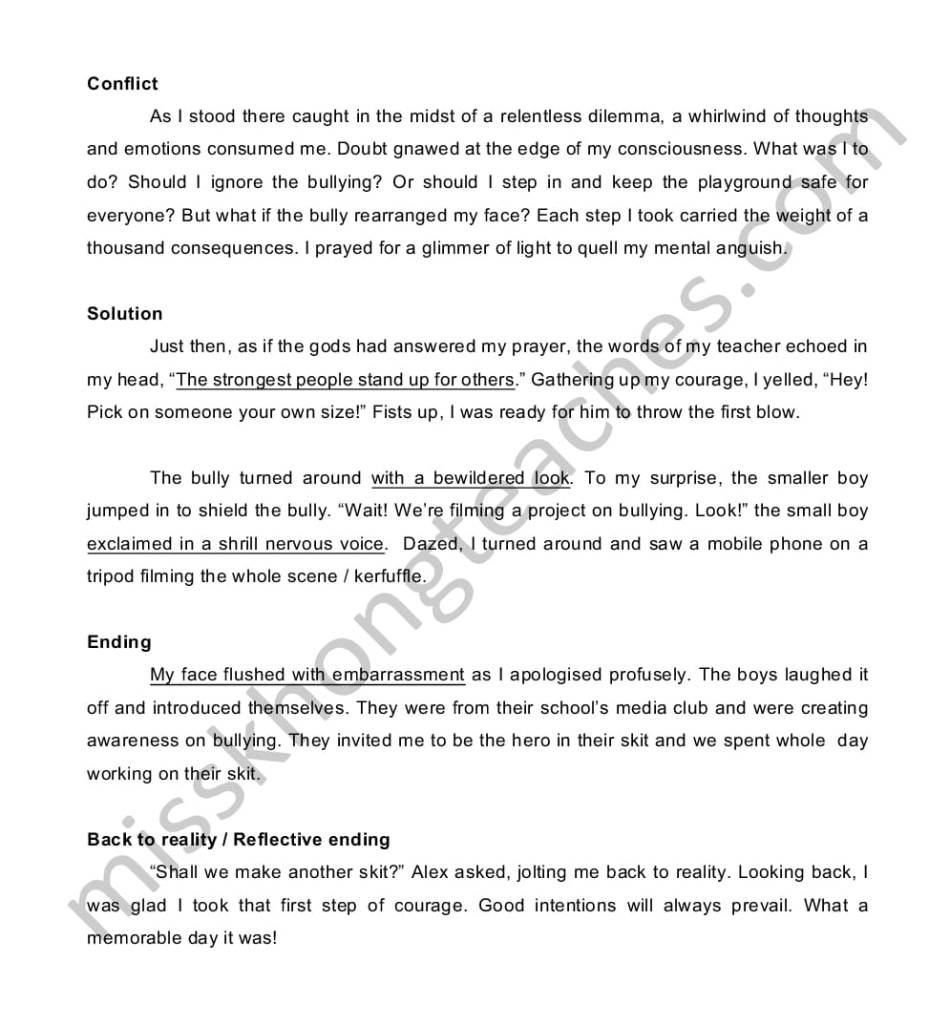
One of the important composition themes, Upper Primary students should master is about being an upstander. Once you have the know-how of describing a bullying incident, and you can show the internal struggle / conflict the protagonist or main character goes through to be an upstander, then it is easy to fit your ideas and content into many given themes. Another possible theme that the sample composition can fit is An Unexpected Outcome or A Surprise. But you do need to change some aspects of the story to fit the theme. Can you think of other themes that this story would suit?
The PSLE English Oral exams will be held on 13 and 14 August 2025. Some parents have asked me what they can do to help their child in this area. With the changes in the PSLE, there is a higher weightage now for the Oral exam. Before 2024, the Oral exam carried 30 marks (10 for Read Aloud and 15 for Stimulus-Based Conversation). From 2024, Oral is now 40 marks (15 for Read Aloud and 25 for Stimulus-Based Conversation).
I’ve noticed that since Covid19, more primary school students have become rather self-conscious and these students prefer to hide behind their masks when possible. Needless to say, their Oral exam is often affected due to lack of self confidence. Besides this group of students, there are also many students who speak monotonously or do not make the ending sounds of words (out of habit).
There are also students who struggle with articulation. That means they can’t coordinate their lips, tongue, teeth, palate and lungs to produce certain sounds.
I believe some students struggle to articulate words well when English is not spoken at home and their school teachers were masked up during the pandemic. I also believe more students flunk their Oral exams post-Covid, then pre-Covid.
One word that many local students mispronounce is “sew”. Firstly, who sews these days? So it is seldom used in their daily conversations yet the word “sew” appears in Comprehension and Read Aloud text and the poor child will often say “siu” instead.
To prepare my students for the Read Aloud, I audio record them individually, reading a passage. I then play it back for the student to hear. They usually laugh at themselves when they realise how flat or rushed or unclear they sound. Since monotony is the main problem, they can see the correlation of their monotony with the sound waves that is displayed on the screen (mobile phone) along with the audio playback. We will then practice clause by clause to correct their intonation, stresses, expressions and ending sounds. Then, we do a few recordings until the student is happy with his/her end result. My motto when it comes to their exams is they “own” it and they stop practising when they are satisfied with their outcome . Only then will a confident child emerge. ( Note for parents: it is the confidence of the child that wins the hearts and marks of the Oral examiners.
When I had been barely into a year of teaching, I was dispatched to another school as a PSLE oral examiner and thankfully, partnered with a very senior, experienced teacher. One student in particular stood out for me because he sat before us “reading” a passage that was not the passage in front of him. I was dumfounded! He had clearly memorised something and he regurgitated it so confidently and fluently! The senior teacher explained to me that the student probably had a severe form of dyslexia and we should pass him because he had taken the effort to memorise a passage from somewhere. I’m not saying that a P6 kid should do what that boy did because every student is different and the examiners will meet each student where s/he is. I happened to meet that p6 boy some years later in a non-profit youth outreach. I remembered him for his outstanding performance. He remembered me for passing him! And till this day, that boy now a man can barely read but he got through school to the best he could.
Below the calendar, I have attached an audio recording of a former P6 student whom I had audio recorded a few times. This is the final product she was satisfied with and she went on to score full marks in Read Aloud for her Preliminary Oral Exams. 15/15 is possible but importantly, read loudly, clearly with confidence and at the end, SMILE and make eye contact with the Oral examiners. YOU GOT THIS!
 Miss Khong's English Class Blog